
BY Lawrence Armoed
Pregnant women are made to sleep on floors and chairs at Dora Nginza Hospital as they wait for a spot in theatre, with the waiting list for caesarean sections getting longer and longer.
Each night the pregnant women watch as nurses roll out thin mattresses which often have to be shared.
Reclining armchairs have also been provided, but there are not enough to go around.
Mothers who have just given birth also sleep on the floor of the hospital’s maternity ward with their babies, using the mattress supplied by the hospital.
On average, doctors working in the maternity ward perform up to 25 C-sections a day.
But the backlog continues to grow as the beleaguered hospital also caters to women living outside Nelson Mandela Bay.
High-risk patients from Humansdorp, Cradock, Graaff-Reinet and Port Alfred are often admitted to the hospital.
Siyolise Davashe of Motherwell started to feel contractions on Wednesday and was rushed to the hospital.
When she arrived, Davashe said, a nurse told her she was close to giving birth and would need a bed.
However, other nurses told her it would not be possible and her name would be added to the waiting list.
It has been terrible. The nurses do provide mattresses for us to sleep on, but we have to share them even though we are all heavily pregnant,” she said.
She said each mattress was shared by at least two women.
“They said we must stay here but with how things are, giving birth at home might be better.”
A woman, whose daughter had just given birth, said even prisoners managed to get their own beds in jail.
I bet they have enough food and beds,” she said.
She said when they arrived at the hospital late on Wednesday night, several women were sleeping in the passageway.
“It is unacceptable that women in such critical condition must do this.”
Provincial health department spokesperson Yonela Dekeda said she was not aware of the issue.
“The matter has not been brought to our attention, but we will investigate the claims,” she said.
A healthcare worker in the maternity ward said there had also been an increase of pregnant women arriving at the hospital.
“The bed issue has been an ongoing problem, but the hospital tried to provide the women with mattresses to sleep on the floor and recliner chairs,” she said.
Another healthcare worker said the hospital often faced backlogs in performing C-sections.
He said the situation was made worse as there were not enough theatre sisters to assist the doctors who performed the operation.
“When a patient has a C-section, they usually spend three days in the hospital.
“This also makes the waiting list for a bed and a scheduled date even longer,” he said.
He denied that expecting mothers were sleeping on mattresses on the floor.
“Shortly after the Covid-19 pandemic hit, the hospital bought about 10 recliners for each ward so that expectant mothers are somewhat comfortable while waiting for a bed to become available.
“They are monitored just like the other patients. Being in a recliner means that you are next in line for a bed,” he said.
But a reporter spoke to several pregnant women and mothers outside the hospital on Thursday after pictures were sent to Daily Kasi News. They all confirmed having to sleep on the floor with mattresses.
Many of the women were seen trying to get comfortable in plastic chairs.
Another pregnant woman, who had been at the hospital for three days, said she feared the cold floor would affect her baby’s health once born.
“It’s so cold at night and this must be a health risk for pregnant women,” she said.
Candice Cornelius said she spent eight days at the hospital, alternating between a recliner and mattresses on the floor.
She was booked for a C-section on March 16 and was told to arrive early at the hospital on the day.
“I got to the hospital and there were rows of women sitting on chairs.
“When I asked the doctor on duty, he told me they were all waiting for the same operation,” she said.
She was told the C-section would be done when a bed was free in the maternity ward.
“It was hell for me. I cried so much. I was 40 weeks’ pregnant, and nothing was being done.
“Then every day they told us after 10pm we must not eat [due to the possibility of the operation taking place],” she said.
She said there was no communication and she had to always ask nurses for food.
“Visitors were not allowed inside. I was in pain and had to walk outside to get food from my family.
“Some days I would just sit there and not collect the food.”
Cornelius said the C-section was done on March 22. She was discharged on March 25.
“What I went through I don’t wish upon my worst enemy.”
Another woman, who did not want to be named, said she was admitted on March 17.
She said she was told they were expected to share a mattress.
“I didn’t sleep at all after that as I then had a bad back.
“I was in the hospital for 10 days and had bad experiences with the nurses who think they own that place,” she said
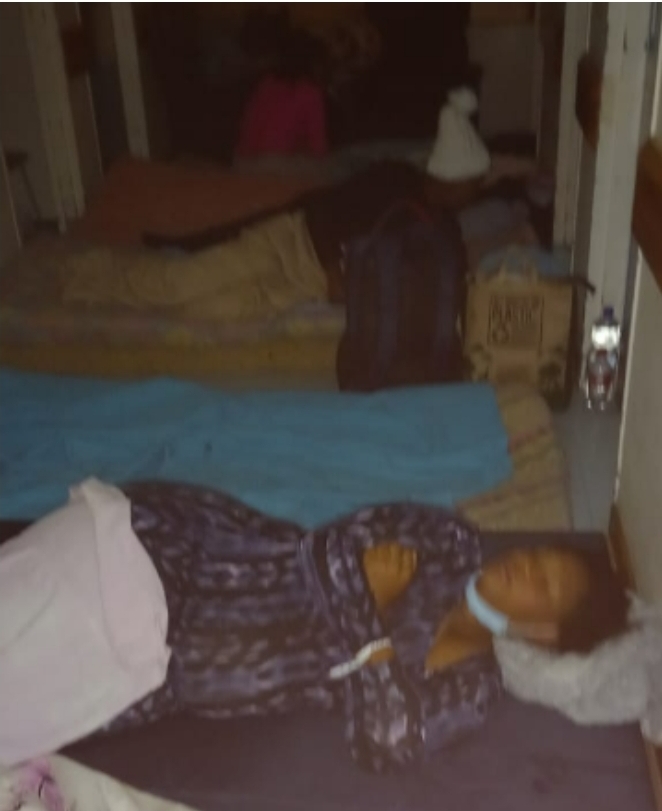
Image: Supplied
 Daily Kasi News