Founded in September 2019, Daily Kasi News (DKN) is an independent online newspaper committed to telling real stories that matter to communities. We deliver credible, ethical and people-centred journalism with a strong focus on issues affecting vulnerable communities and human rights.
At DKN, we believe journalism should inform, inspire and create positive change. Our news reports, features and opinion pieces are written in clear, accessible language to keep communities informed and engaged.
We proudly remain independent and non-partisan, giving a voice to ordinary people while maintaining high journalistic standards. Our articles are also available for republication under Creative Commons licensing, allowing important community stories to reach wider audiences.
🗞️ Breaking News | Community Stories | Sport | Entertainment | Opinion
🌐 dailykasi.news.blog�
📱 WhatsApp: +27 83 220 1851
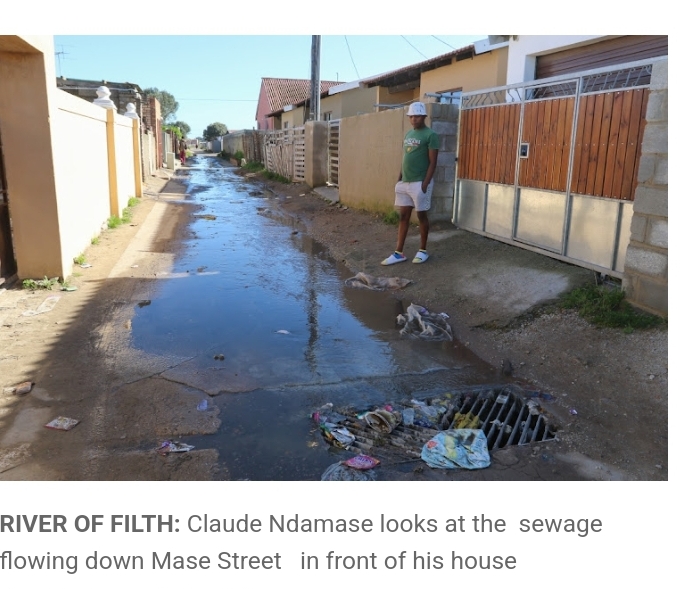
Sewage is stinking up Mase Street in Kwazakhele, with the foul-smelling waste flowing down the entire road.
Residents have had to brave the stench every day for years as at least four outside household drains keep blocking, leading the sewage to stream down the street.
In some cases, the sewage seeps out of bathtub drain holes, leaving residents desperate for hPersistent water leaks are also a problem in Mase Street.
A Metro Matters team managed to find the street while driving in Kwazakhele as the pungent smell gets worse the closer you get to the street.
Residents have been struggling for months to get the municipality to attend to the blocked drains.Siphokazi Ndamase said his grandfather’s medical condition was getting worse due to the problem.She has reported the issue to the metro for several years.
“Ward office officials and plumbers would come to check but then never return,” she said.
The blockages are sporadic and often stop for a few days every month.
Claude Ndamase said he grew up in the street and the problem had been going on for years.Due to the years of leaking, the floors of his family home had started to crumble and paint was peeling off the walls.He said the house’s foundation had also been damaged.
“For years, we had been living like this. The house is cold and always moist.
“It is very frustrating as we watch our home destroyed with little to nothing we can do,” Ndamase said.
He said several calls had been made to the municipality and different reference numbers would just be given.
“I had to dig trenches inside the garden for the sewage water to run down the street.
“We live with our sickly grandfather and we are worried about his health,” he said.
Ndamase said human waste would often run down the street.
“We are living and breathing this in every day.
“Sometimes we would be told the problem is connected to a main sewerage pipe and that we must wait,” he said.
His neighbour, Nomveliso Tyala, who has a blocked backyard drain, said his house was always filled with flies and mosquitos.
“This is getting worse. I don’t know how many times we have reported the matter to the metro.”
She said for years residents had been reporting the issue to different ward councillors.
“We live in filth and no-one should live like this.
“We can’t open windows and our gardens are full of water.
“It’s even difficult to walk down the street.”
Ward 19 councillor Gamalihleli Maqula said he was aware of the problem and had escalated the issue.
“I was alerted about the matter this year and told it’s been a problem for years.
“I have informed the relevant departments and they are busy with a plan to solve the issue,” he said.
Municipal spokesperson Mthubanzi Mniki did not respond to a request for comment.
Provincial police commissioner Lieutenant-General Nomthetheleli Mene received a rude reception from KwaNobuhle residents who vocalised their dismay about poor service from their police station.
Mene spoke on Friday at an imbizo at the Babs Madlakane Community Hall in KwaNobuhle, where more than 150 residents said the police in the area had failed to protect and serve the community.
Nelson Mandela Bay district commissioner Major-General Vuyisile Ncata and Bay mayor Eugene Johnson were among the dignitaries who were in attendance.
The purpose of imbizo was to interact with the community on issues relating to service delivery, client satisfaction and community involvement.
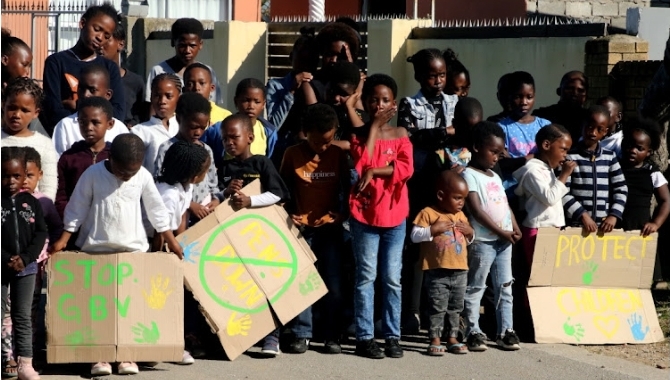
It was preceded by midweek buildup activities including awareness campaigns in shopping malls and visits to three schools, Nkululeko, Phaphani and Sikhothina, where senior managers spent time engaging with pupils about liquor abuse, drugs and gender-based violence. KwaNobuble resident Mzwakhe Thompson placed the blame for poor service delivery on the KwaNobuhle station commander.
“I wish you [Mene] would have not announced that you were coming and sent two delegates to see how we are treated at the police station,” he said.
“He [the station commander] must go.
“There are serious cases.
“Recently a woman was killed by her son. Residents tried to call the police but eventually gave up.”
Ward 43 ANC Women’s League chair Maliwe Grootboom agreed that the KwaNobuhle station manager should be removed.
“Since this new station manager arrived things have changed.
“We used to work with the police, now the police have turned on us.
“Last year, we had operation to put an end to a house that sells drugs.
“We found the drugs, but when we arrived in Mkomko we found the police were stealing the same drugs.
“As we speak we do not know where that case ended up.
“Investigate the people you are hiring. [Even] dockets go missing,” Grootboom said.
Ward 45 councillor Sabelo Mabhuda said violence in the community had increased, while unity among community members had decreased.
In response, Ncata said he was newly appointed in his position, but had noted their complaints.
“I was tasked by the provincial commissioner to pay attention to this police station,” he said.“I am glad that you have spoken. The community will not want to work with someone they do not trust.
“I have been here for four days. I saw some of the complaints.
“We will have an intervention plan for the KwaNobuhle police station, from the cleaners to management.
“We will give you feedback on those complaints.
“We will need to have a structure so we can talk about what we have fixed from your complaints, however, the community needs to play its part.”
The community applauded and said they were willing to work with him to fix the broken trust between them and the police.
When Operation Sikhona started on Thursday, provincial management and Ncata conducted an operation in KwaNobuhle.
Police spokesperson Colonel Priscilla Naidu said Operation Sikhona had seen stop-and-searches, vehicle checkpoints, visits to taverns, suspect tracing and road blocks conducted.
A total of 69 people were arrested for crimes including rape, assault with intent to cause grievous bodily harm, burglary, drunken driving, illegal possession of firearms and ammunition.
Large quantities of alcohol, dagga, cocaine, knives and stun grenades were confiscated.
Two hijacked or stolen vehicles were recovered and 177 fines issued.
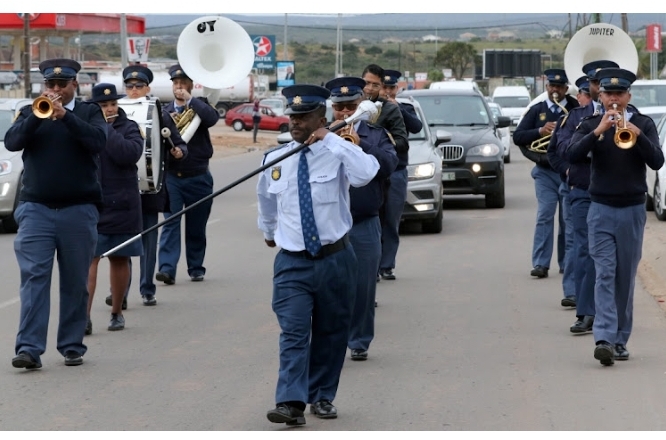
The SAPS brass band arrives at the Babs Madlakane Community Hall in KwaNobuhle as part of Women’s Month celebrations Image Phumlani Saul
A six-year-old boy accidentally shot dead his five-year-old cousin in Gqeberha on Thursday afternoon.
Eastern Cape police spokesperson, Colonel Priscilla Naidu, said the incident happened in Bethelsdorp between 13:00 and 14:00.Naidu said the boy allegedly shot his cousin in the head with a .38 revolver.
According to the police, three children – two boys, both aged 6, and a girl, aged 5 – were playing with the firearm in a room at a house in Extension 31, when a shot went off.
Naidu said an ambulance rushed the girl to hospital, where she died.
The police are investigating charges of culpable homicide and defeating the ends of justice, although no one has been charged as yet.
Naidu said the police added the charge of defeating the ends of justice because the firearm could not be found after allegedly being removed from the scene.
“More charges may be added, and arrests effected as the investigation unfolds,” said Naidu.
The South African Gunowners’ Association (SAGA) called on gun owners, especially those with small children, to lock their firearms in safes when the weapons were not under their direct control.
SAGA chairperson Damian Enslin said:SAGA said while it was not clear whether the firearm used was licenced or not, it believed in responsible gun ownership and that all lawful licensed firearm owners should comply with the law.
The Firearms Control Act states that when a firearm is not on the gun owner or under their direct control, it must be locked in a safe that complies with the regulations.
SAGA described the incident as “tragic and terrible”.
Gun Free South Africa, an NGO committed to reducing gun violence, could not immediately comment. Their comment will be added once received.
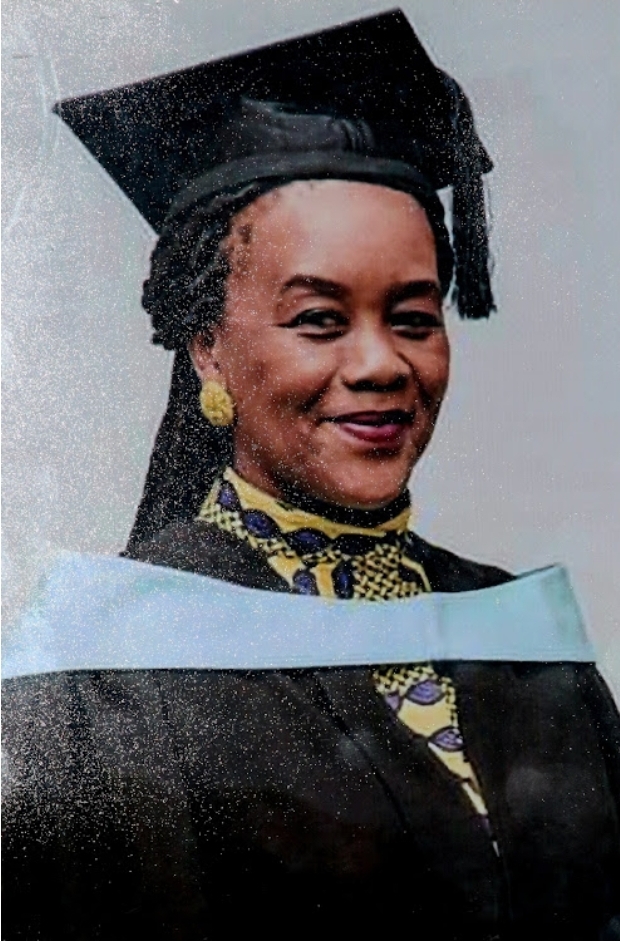
Justice must be served not only for Bongiwe Wendy Hani, but for all women brutally killed in SA.
This was the sentiment among Hani’s family and friends who gathered to celebrate her life after she was gunned down at a preschool in New Brighton last week.
Hani, 52, was shot dead while cooking food for the children at the Ekhayeni preschool.
The gathering was held at the school on Tuesday.
Hani’s brother, Zibula, pleaded with the police to speed up the investigation and arrest the two culprits.
He said Hani had devoted her life to her job and was loved by everyone in the community.We are devastated as a family but we are coping.We never imagined that she would die in a very gruesome manner.
“We hope all involved will be arrested,” he said.
He said his sister had a passion for children and could relate to them regardless of the age difference.My sister loved children. She was more than a teacher but a mother to all of her children.”
Her colleague, Ntombentle Bangani, described Hani as a joker who strived to make everyone laugh.
“She was a people person and always smiling. She was always there for people.She said Hani would be remembered for her kindness.
Hani will be buried on Saturday.
Police spokesperson Colonel Priscilla Naidu said two armed men had entered the creche and demanded money while one of them pointed a firearm at Hani and a co-worker.
Naidu said the second perpetrator cocked his firearm and a shot went off, injuring his accomplice.Both victims were then ordered to lie on the floor and Hani was shot in the back by the injured suspect, who then staggered out.”
The other man also shot Hani in the head.
“Nothing was taken,” Naidu said.
SHOT DEAD: A memorial service was held for Bongiwe Wendy Hani, who was shot dead at a New Brighton preschool last week Image: suppliedLOVINGLY REMEMBERED: A memorial service was held on Tuesday for Bongiwe Wendy Hani, who was shot dead in front of the children at the New Brighton preschool where she worked last week Image: Nonkqubela Maliza
The Nelson Mandela Bay metro in the Eastern Cape is in the grip of a severe drought after seven consecutive poor rainy seasons.
Some of the metro’s 48 clinics and three referral hospitals have had to close temporarily or shorten their operating hours.
Speaking to Spotlight on condition of anonymity, a nurse working at a clinic in Kariega (formerly Uitenhage) says: “The clinic services are constantly disrupted due to intermittent water supply. Sometimes we are forced to shut our doors and attend only to emergencies and distribute medication, leaving patients stranded. Lack of water creates an unhygienic environment contrary to the Occupational Health and Safety Act requirements.”
Meanwhile, the health department confirmed an outbreak of non-Typhoidal Salmonella, specifically in the Kariega area, where water provision is severely limited. The drastic water cuts have repeatedly forced some public health facilities in the area to shut their doors early, while others don’t allow patients to use the toilets.
The provincial health department remains optimistic that it can manage the situation.
Nelson Mandela Bay metro’s district manager for health, Darlene de Vos, says the health sector has no option but to continue functioning – even if the taps run dry.
“We have been monitoring the water situation carefully in recent weeks as this is an incredibly challenging time for our city,” she tells Spotlight.
Water outages may already be contributing to outbreaks, although the evidence isn’t yet there to prove that specific outbreaks were due to water shortages.
“There is a lot of non-Typhoidal Salmonella among children. We have not seen a remarkable increase, but every week we do get up to four cases and surprisingly more in the Kariega area than in Gqeberha,” she says.
De Vos says they do get a daily report from the National Institute for Communicable Diseases (NICD) to help manage the infection appropriately.
According to Professor Mrudula Patel, of Wits University’s Clinical Microbiology and Infectious Diseases Unit, non-Typhoidal Salmonella is common in children if strict hygiene controls are not implemented.
“The infection can be transmitted from one child to the other through contaminated food or water that will be ingested,” says Patel.
“Cross-contamination can also occur through handling vomit and stool. Again, utensils, food and water have to be free of pathogens, and, most importantly, hand hygiene of the healthcare workers through disinfection is important. Healthcare workers need to be made aware of new infection control measures,” says Patel.
According to a fact sheet from the World Health Organisation, “Salmonella is one of the four key global causes of diarrhoeal diseases”, with about “550 million people falling ill each year, including 220 million children under the age of five years”.
“Bacteria can be transmitted by contaminated drinking water and cause diarrhoea, including Shigella, Campylobacter, which is a certain type of E. coli, and non-Typhoidal Salmonella,” explains Dr Linda Erasmus, of the Centre for Enteric Diseases at the National Institute for Communicable Diseases.Erasmus says cases of children in the Nelson Mandela Bay metro, with non-Typhoidal Salmonella, would need further investigation to identify the possible source(s) of infection.
“Without further information, we can’t speculate as to the likely cause(s) in these cases,” she says.
She says the NICD monitors several important diarrhoeal infections, including cholera, enteric (typhoid) fever, Shigella, and non-Typhoidal Salmonella.
“Unusual patterns of disease or a sudden increase in case numbers would be cause for alarm and trigger further investigations,” says Erasmus.De Vos says Rosedale Clinic (in Kariega) suffered the same fate around January when it was without water for two weeks.
“Without water, a health facility cannot run. Water tanks have been placed at clinics in the red zone areas to store water. The tanks are being filled up every week to mitigate the impact of the metro’s water problems on the health service delivery efforts,” De Vos says.
There are at least 10 clinics, one hospital (Elizabeth Donkin Hospital) and one private clinic in the red zone area.
According to Patel, this is an incredibly challenging time for the city, as water in the healthcare setting is essential for washing patients, bedding, utensils, and floors.
“If there is no water, infection control is not possible. Disinfection of items that are not washed is not ideal, but it can minimise cross-contamination. Sufficient water should be sourced at least for the sterilisers, so that surgical instruments can be sterilised through steam-operated autoclaves to ensure the continued operation of theatres,” he says.
He says hospitals should have plastic drums for water storage as reserves because metal drums corrode and the rust seems to support the growth of enteric bacteria.
“Water can be decontaminated regularly using appropriate disinfectants, but should not be exposed to the skin and other surfaces.”De Vos says there are various water augmentation projects underway to ensure that hospitals don’t run dry amid the ongoing drought.
“Boreholes are being drilled to alleviate pressure on our water reserves and to make sure we don’t reach a situation where we cancel surgical procedures due to a shortage of water. All our hospitals have backup water supplies, but it’s not as much as we would want to have, but all of them do have water tanks that supply facilities with water when there are outages,” de Vos says.
The municipality now ferries water from the eastern side of the city, which is less affected because they get water from the Nooitgedacht water scheme.
She says organisations, such as Gift of the Givers and the Nelson Mandela Bay Business Chamber, along with the municipality, have all chipped in and are making sure health facilities are not left behind.
“They opened a borehole at the Elizabeth Donkin Psychiatric Hospital and Jose Pearson TB Hospital that produces 14 000 litres per hour. A 220m borehole has also been sunk at Livingstone Hospital and Port Elizabeth Provincial Hospital. Should the hospital experience water shortages, the boreholes will immediately kick in, which means our health facilities will not come to a standstill, even if Day Zero arrives,” says De Vos.
The senior director of Nelson Mandela Bay Water and Sanitation, Barry Martin, insists there is enough water capacity to augment the city’s water supply and hospitals won’t come to a standstill, even if Day Zero arrives.These included the drilling of a borehole to keep the lifeline of the bulk water supply that feeds these hospitals alive. The implementation of these measures was to mitigate the risks associated with having no or intermittent water in healthcare facilities. It is through that bulk network that emergency water supply will also be fed to ensure the ongoing provision of healthcare and the safety of patients.”
Martin says the municipality is also fast-tracking the drilling of boreholes.
“However, to compensate for the metro, we have had to put the necessary controls in places such as communal water collection sites and standpipe collection points to alleviate pressure on our water reserves at the hospitals. We have already looked at how we can bring whatever water we have into the stream and we have looked at those contingency plans.”
He says they have made “great progress” to alleviate Day Zero, such as drilling more boreholes and diverting water from Nooitgedacht Water Treatment Works to other red zones. (Red zones are classified as areas that are most at risk of running out of water).
“But that would not mean that we will relax our water restrictions,” he cautions, adding that residents should be cautious with their water consumption.
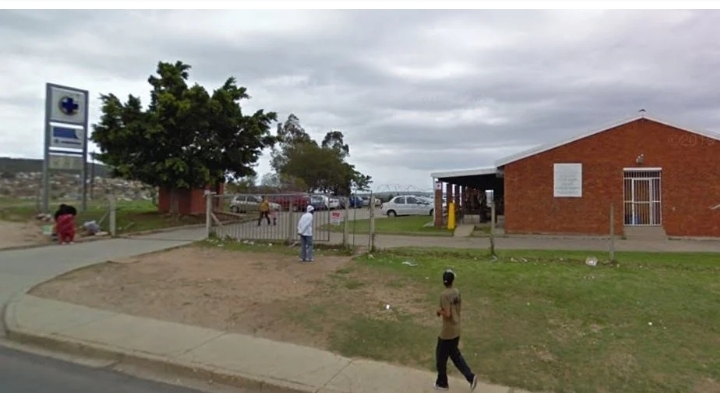
Water outages may also be contributing to outbreaks of disease. Rosedale clinic in Kariega
Just more than 40 municipal vehicles damaged due to negligent driving have been left dumped at the Nelson Mandela Bay municipality’s Deal Party depot since the beginning of 2022 — with officials unable to fix them due to a lack of documentation or accident reports.
This was revealed during an oversight visit to the depot by roads and transport political head Itumeleng Ranyele on Friday. Nelson Mandela Bay’s fleet management director, Zukile Magongo, said the vehicles included:
Eighteen from the traffic department; Eight from the safety and security department; Five from the metro police; A pail truck; and Nine refuse trucks. Magongo said the vehicles were left standing as officials failed to produce the necessary documentation after the vehicles were damaged due to accidents.
A further 16 vehicles could possibly be written off.
“Going forward, we had made arrangements for officials to bring in the necessary documents when bringing in cars as we are not able to proceed without the reports,” he said.
Magongo said the biggest culprits were traffic officers and security officials.
The latest accident involved an official allegedly driving under the influence of alcohol.
We do follow-ups on the vehicles and most of the time it is viewed that fleet management is not doing their jobs.
“However, officials are failing to provide reports, and for other interventions, it would require funding as we would need personnel to visit the officials to collect the vehicles,” he said.
If repaired vehicles were not collected, they were auctioned off.
This, he said, saved the municipality money as the city would no longer be paying for insurance.
“So far, 300 vehicles have been auctioned off already.”
He said a further 480 vehicles would be auctioned off in the near future as they remained uncollected.
Safety and security acting executive director Shane Brown said every department was responsible for reporting accidents.
“The report will ascertain if the official can be held liable for damages, therefore it is each directorate’s responsibility to do this,” he said.
Councillors at the oversight visit were shocked that officials were not filing accident reports.
ANC councillor Gamalihleli Maqula proposed that all vehicles not in use be returned to the various departme
nts until officials provided the necessary documentation.It can’t be that they get away with this,” she said.
Police spokesperson Priscilla Naidu said it would be difficult to check the police’s database regarding the official allegedly driving under the influence of alcohol.
The Herald reported in July that it takes the municipality’s fleet department two weeks to repair a flat tyre on a small car.
It also takes about two months to repair a refuse compactor truck and a week to fix a broken windscreen.
Adding to the department’s woes is its obsolete vehicle-monitoring system, which creates the ideal conditions for staff to abuse the city’s cars.
At the centre of the department’s challenges, Magongo said, were staff shortages and the lack of a succession plan to replace key officials when they left.
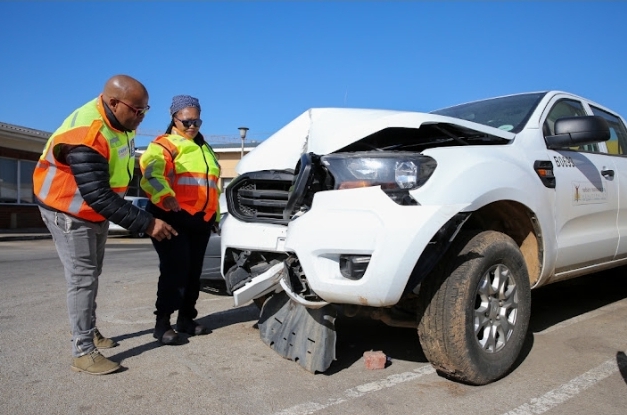
OUT OF ACTION: Nelson Mandela Bay roads and transport political head Itumeleng Ranyele, right, and fleet management director Zukile Magongo inspect a vehicle damaged by a safety and security department official on Friday picture: Supplied
Three brothers were shot dead in Motherwell on Wednesday leaving residents in the street shocked by the brutal killings.
Police spokesperson Captain Gerda Swart said the owner of a house in Mlele Street heard several gunshots at about 8pm but did not go outside to check.
“After hearing a vehicle driving away, the owner emerged from his house,” she saidHe discovered the body of his son, aged 24, lying at the entrance of his flat at the back of the property.”
Swart said the bodies of the man’s two other sons, aged 17 and 21, were found inside the flat.
“All three victims were shot in the head,” she said.
The Provincial Organised Crime Investigation Unit is investigating the case.
He discovered the body of his son, aged 24, lying at the entrance of his flat at the back of the property.”
Swart said the bodies of the man’s two other sons, aged 17 and 21, were found inside the flat.
“All three victims were shot in the head,” she said.
The Provincial Organised Crime Investigation Unit is investigating the case.There were no screams heard while any of this happened,” she said.
“We just heard the father sobbing, asking what he was going to do with the bodies of his children.
“I could not sleep. They grew up in front of us.
“We never imagined they would die like this.
“Whoever did this came to kill them.
“We can’t begin to imagine the pain the father must feel.Another resident said: “This is scary because we have children at our own homes.”
Owner shot in Despatch as heavily armed robbery gang hits busy drinking spot..
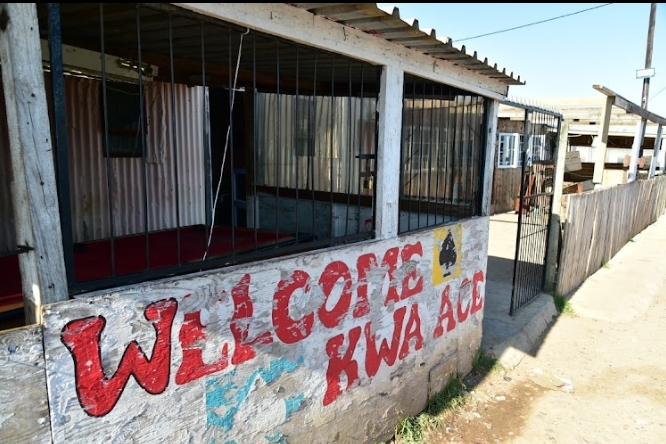
A group of heavily armed men opened fire outside a crowded Despatch tavern early on Sunday, forcing patrons to duck for cover, with the owner shot in the leg later.
The 15 men arrived at Ace’s Tavern in Kingstown in a Quantum taxi at about 3.30am, fired several shots outside and then a few more inside the premises.
They made off with R6,000 in cash, alcohol worth R30,000 and several cellphones.The brazen robbery was one of the latest in a flurry of tavern shootings in SA, after the massacre earlier in July in which 15 people were killed and eight wounded at Mdlalose’s Tavern in Soweto.
Several other tavern shootings have also thrust SA’s sky-high crime rate into the spotlight again, with an uptick in violent deaths.
Ace’s Tavern owner, Ayanda “Ace” Kakaza, 34, said he was asleep in his bedroom adjacent to the establishment when he was woken up by the sound of gunfire.
Before he could get dressed, and just seconds before the gun-wielding men barged into his room and dragged him into the tavern, he was hit in the leg by a bullet.
About 50 patrons had been drinking and playing pool just before the 15-minute robbery started.
A customer, who declined to be named, said he was playing pool when the men arrived.
“They fired shots outside and came in, ordering all of us to lie down. Some then went to the owner’s room,” he said.
“When they were dragging him out of his room and into the tavern, we all kept still on the floor as they flashed their guns around.”
Bleeding and confused, Kakaza was insulted by the men as they dragged him to the tavern’s counter and demanded money.
The other men forced the patrons to hand over their cellphones.
“The minute I heard the gunshots, I panicked and immediately reached for the [electrical circuit panel] in my room,” Kakaza said.
“I turned off the main switch and the tavern became dark.
“Just as I was about to go outside, some of these men were already banging on my door, ordering me to come outside.
“I tried to hide next to my bed but they shot me.”
Kakaza said the men demanded money but he had to explain they had already bought new stock.
“They then dragged me to the counter to get what money was left,” he said.
Kakaza said the cashier handed over the R6,000 wrapped in a black plastic bag.
The men then emptied his shelves, taking bottles of cognac, whiskey and gin.
“After I gave them the money, I tried to lock myself behind the counter but one of them pointed the gun at me.”
Two bullets narrowly missed Kakaza’s head — hitting the wall behind him.
Angered by Kakaza’s attempt to lock himself behind the counter, one of the robbers hit the owner’s head against a glass fridge door, which shattered.
Bafundi Jini, 30, who was playing music in the DJ booth just before the robbery took place, said some of the assailants also stole sound equipment.
“When they got to the DJ booth, they forced me to lie down and took everything.
“After taking the equipment, they took one of the cars that was parked outside.”
Jini said all the men were armed with firearms.
Police spokesperson Colonel Priscilla Naidu confirmed the robbery but said only five men had stormed the tavern.
“An e-hailing driver parked opposite the road was thrown out of his Toyota Corolla.
“[Some of the] suspects got into the car and drove away.”
Owner shot in Despatch as heavily armed robbery gang hits busy drinking spot
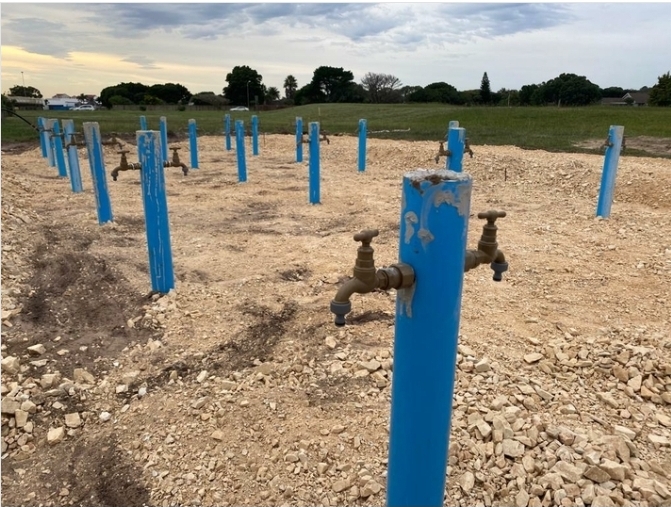
Nine of 24 communal water collection points in the Nelson Mandela Bay Metro will be activated on Saturday.This was announced by Metro’s multi-party political oversight Committee on Thursday.
Currently, the Metro is not extracting water from the Impofu dam because the barge is being relocated and over the past week, Churchill dam has been carrying most of the Impofu dam’s shortfall and is now also seriously depleted.
Chairperson of the Amatola Water Board and leader of the Intervention Team, Pam Yako recommended to the committee that the Churchill dam’s supply be cut immediately to reduce consumption and prevent dam failure due to over-extraction.
The recommendation will see extraction from Churchill dam reduced from 60 ml/d to 25 ml/d and as a result, the dam will run dry by Tuesday the 28th.
This will have an impact on the southern and western suburbs of Nelson Mandela Bay, including parts of New Brighton and Kwazakhele.
Residents in these areas will experience intermittent water supply as a result of the reduced extraction.
Initially, the nine collection points will be activated to operate 24hrs a day and are expected to last for at least seven days.
More information on the exact locations and availability of these augmentation supplies will be published shortly on all municipal communication platforms.
Collection point along Buffelsfontein Road during construction
Health professionals have called on South Africans not to resort to bigotry around monkeypox.
On Thursday, the first case of the disease was confirmed in a 30-year-old man in Johannesburg.
The man has no history of international travel, according to Health Minister Joe Phaahla.
“The disease only spreads through close droplets, so you cannot get it by being in the same room with an infected person. Thus far, it has been dominant in men who have sex with men, but the main feature is that transmission is through close contact.”
The disease was previously reported in African countries, such as Nigeria, the Democratic Republic of Congo, the Central African Republic and Ghana, in the early 2000s.
The current outbreak was reported in the United Kingdom, Spain, Germany, Portugal and France.
Phaahla said the National Institute for Communicable Diseases (NICD) was conducting online, in-service training for health workers to be able to detect the disease.
Professor Kolela Mlisana, who co-chairs the Ministerial Advisory Committee on Covid-19, said all people were susceptible to infection.
“It does not mean it gets transmitted through men who sleep with men, but any direct contact. We are seeing this trend because that is probably how it got introduced in countries outside Africa. The important thing is that we are able to diagnose it, and it is going to be important to contact trace. Right now, it is one case and up to us, as lab people, to be on high alert.”
The NICD warned against stigmatising gay people or men who sleep with men.
Please be aware that the information shared about monkeypox was to provide epidemiological context for the current multi-national outbreak. It was by no means to profile any members of society.
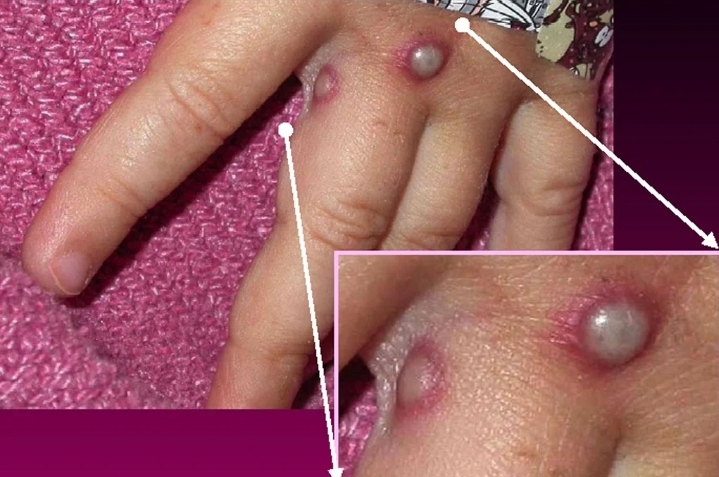
“We would like to stress that any persons, regardless of gender identity or sexual orientation, can acquire monkeypox – if they have had close contact with someone infected with the virus.”The disease presents in skin lesions and spreads through close contact – like sex, hugging and cuddling.
A communique by the NICD on Thursday said the disease presents with an acute illness characterised by fever and general flu-like symptoms, followed by the eruption of a blister-like rash on the skin. The disease is rarely fatal, and cases typically resolve within two to four weeks and usually does not require hospital treatment.
“Treatment is symptomatic and a doctor may prescribe medication to treat pain, fever and other discomforts. It is important to keep hydrated, and prevent scratching or bursting the blisters to prevent infection with bacteria. The rash is generally not itchy, but may become itchy when the skin lesions are almost healed.”



You must be logged in to post a comment.